Mostrando postagens com marcador Helio Oiticica. Mostrar todas as postagens

terça-feira, 1 de dezembro de 2009

Brazilan Art and film - Helio Oiticica


My own picture of the police at the G8 protest, London, April 2009. The shock of the middle classes when the police fail to show respect. I had to use all my 'schoolmarm' powers on a police officer to escape the 'kettle tactics'. The orders were clearly based on a fear of a much more aggressive demonstration than was actually happening.

Event this week.

Dr Karl Posso
Department of Spanish, Portuguese and Latin American StudiesUniversity of Manchester

Suspended Animation: Affect and Affection in Tropicalist Brazil

This paper will examine the central function of the affective image and object in a
selection of works by ‘Cinema Novo’ filmmaker Glauber Rocha (1939-1981) and the
neo-concrete artist Hélio Oiticica (1937-1980) produced during Brazil’s ‘Tropicalist’
period of cultural experimentation in the late 1960s. The concern with social and
political issues at the time of the military dictatorship led Rocha and Oiticica to
attempt to displace conventional knowledge and recognition in order to develop
artistic modes for intervening ethically in the world. Affection in their work becomes
less a question of what is represented – transcendent ideals – and more a case of
violent sensation, a means of interrupting action-reaction circuits: this shift towards
the affective suspension of representation, and of judgement, in/by their work, I
argue, functions as a timely event of ethical intensity.

A paper to be given on Thursday at Cambridge University, and which I would like to hear…


But I have 2 preliminary thoughts. One is that this particular combination of filmmaker and artist was featured at the Tate Modern in 2007, and one of my concerns then about the published work on Oiticica in particular was the arguement that as an artist he was a 'universalised' creative, and not influenced directly by thinking about the poverty problems around him until later in his career. He was not the only Brazilian in the late 1950s to change direction on this - and most important was the art critic, Ferreira Gullar, who had promoted Oiticica, but who became a poet, and went off to Recife to participate in Street Theatre and other direct action cultural work. But there was a French PHD student in Art History from Manchester University speaking at the Tate Modern seminar, who I hope has learned more about the sitituation in Brazil since then. Manchester has some good Brazilian academics in post. Oiticica's work is placed in the care of Texas University, which also has other Brazilian artists work. I am not sure it serves them well if it excludes the environment in which the work was created. Brazil needs this material in its own institutions.

The second point is that I feel by working from the artistic work, to the restrictive event (the didatura) to the change in focus as 'ethical' it ignores signs in the artistic production prior to 1964 - and Glauber Rocha was radical from the begining. My own work with the artistic influences on Joao Cabral de Melo Neto, who was critically interpreted as following an intellectual art appreciation of Miro - image - poem, rather than thinking what images and politics did Cabral instinctively use as a man from Recife, and place in his work. The phrase 'misleading ideas' is much more subtle when, even more than 'tropicalia', the idea of hiding radical truths about Brazilian society in learned cultural discourse of internationalised art is engaged. Of course Cabral had to be 'politically protected' in the Diplomatic Service. The colour idea is key - has Posso picked up on that I wonder. Well I don't mind if my own ideas turn out to be the same as everyone else. I am sure that as a professor, Karl will be much better able to express himself than I can.

I had another quotation that I have been keeping in reserve in thinking about aesthetics of poverty.


"..only what is repressed is symbolised; only what is repressed needs to be symbolised" .


This is apparently from Ernest Jones (1916) who was a contemporary of Freud in Vienna - I don't know the original source, this is in Freud for beginners (1979) p 173. I expect it relates to dreams, not politics.
One last Brazilian puzzle for today. The significance of the 'yellow mercedes' in Clarice Lispector's The hour of the star. Discuss in relation to the 'yellow mercedes' in Amarelo Mango.

sábado, 16 de junho de 2007

Cesar Cornejo - Education and Peru and Colour in Culture


Siempre la misma historia (The same old story), Cesar Cornejo, 2004.

I am off to to London to see the third Glauber Rocha film at the Tate tonight - Terra em Transe. It is so sad that the curator of this film series, who I have spoken to, did not organize a 'talk' session of some kind, to go with the series. It would be great to have a discussion with some of the other people who are coming to see these films.

But I did enjoy the discussions at the day symposium the Tate held on the work of Helio Oiticica on 2nd June. It was an interesting mixture of academics, art curators, conservators, journalists and artists so the talks varied greatly in detail and in approach. And I was brave enough to spend time talking to some of the audience and speakers, in particular an artist called Cesar Cornejo, who is from Peru. He trained originally as an architect, did his sculptural training and PHD in Japan during the Fujimori years, and now does some installation work which he calls anti-architecture. In some ways his career is like Helio's travelling from 'concrete organizational purity' to work much more socially concerned.

La Cantuta - a grief for a Peruvian tragedy - Cesar Cornejo

2005


The symposium was on 'colour' in Helio Oiticica's work, but it was more about the artistic technicalities than the political issues about 'coded' and 'countercultural symbolism' - the latter is a very 'walking on eggs' area, and led to some quite impassioned (for academics) discussions !!! He does use a lot of yellow, but well before 1964, in his 'concrete period'. But as my Recife intellectuals of the 1950s and 1960s were quite plugged into this as well, I think the cultural debates within Brazil are more interesting and a more fruitful area of research than worrying about whether it is part of international trends of the time (Yves Klein etc). that is because it can be traced in poetry of the period in Recife, and possibly elsewhere. The literary writer I have been considering in relation to this is Carlos Pena Filho and his Soneto do Desmantelo Azul. This was the subject of an earlier film by Claudio Assis ( Amarelo Manga) made in 1993 and called in deference to internationalism Soneto do Desmantelo Blue.

Soneto do Desmantelo Azul
Então, pintei de azul
os meus sapatos
por não poder de azul pintar as ruas,
depois, vesti meus gestos insensatose colori,
as minhas mãos e as tuas...
Carlos Pena Filho(1929-1960)


Actually those who make claims about international influences (ie Western) as dominant are easily revealed as 'Euro-centric' First World cultural snobs. Same problem popped up over the discussions about Helio Oiticica's own post 1959 work, after he worked inthe Mangueira favela in Rio and discovered the structural realities of temporary housing. (It is very damp !.)Contemporary European work (on building materials and structures ) in the same area is derivative of activity in marginalized places, which it then 'universalizes' as a world concern which needs artistic expression, but in the process of course, further marginalizes the very cultural expression which told the story in the first place.


To see the work of Cesar Cornejo - see http://www.cesarcornejo.com/
To see information about Helio Oiticia exhibition - see http://www.tate.org.uk/

quinta-feira, 17 de maio de 2007

A sign to keep going ! Glauber Rocha at the Tate Modern

I often find that when I am very worried about keeping going on this work that I get a 'signal' - something I see on TV or read in the paper is about Brazil. I know it is just a nonsense and I see it because I am 'looking' for it mentally, but it makes me feel heartened, because despite the last post I really love Brazil and its people.


And just as I was working on this tragic 'knowing' episode my nephew arrived home from work and brought up the mail - because I really had been on the computer all day - a progress from television ! And there was the brochure for the Tate - I can't afford to be a member this year, but they still send the programme. And the Helio Otiticica exhibition is on, which I knew, and along with it in June and July - all the Glauber Rocha films the 'novo cinema' of the 1960s I need to see ! I have seen only one of them - O deus e o diable , which was shown to me by my Portuguese language teacher (Newton) in Recife. It features the music of Vila-Lobos and I knew about the film before I ever saw it thanks to another very clever Brazilian friend. You can see some of these on DVD, but it is far nicer to go to the Tate and watch them with other interested Brazilanistas and Brazilians living in London, because they are very political and interesting films - although like all such films, too intellectual for popular appeal, and then banned by the dictatorship. So I need to be finished!! I need to see these films so I need money and I need to be in London !!!!

The Oiticica exhibition is having a seminar about his use of colour - which is deeply involved in the same ironic work of the same period - essentially anti-symbolic, which is explored in my Amarelo Manga film also. So I have been on the right track, just far too slow to write it all down.

Oh god, I feel better.

I meant to give you all some detail about Amarelo Manga. It seems appropriate to choose one in relation to public grief and anonymous grief over death. One of the more shocking episodes in the film is when a dead male body - or 'yellow ham' is supplied by a corrupt official for a character interested in necrophilia, to use for target practice as a private 'turn on '. In contrast when the owner of the 'Hotel Texas' dies, there is much shock and consternation while the money is found for a coffin and he is laid out in the hotel with the residents singing traditional dirges. Both scenes are replete with referencing to other films and cultures, but the contrast is intended to reflect the difference between a community that 'cares' for whatever reason - and one that does not. One who 'needs' a priest and a ceremony and one who does not.

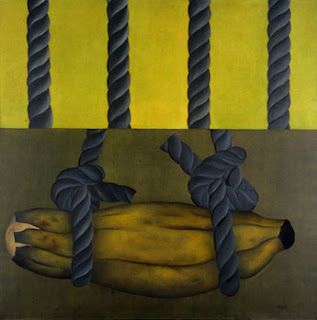
This picture is from 1973, by A H Amaral, called Banana in green and is typical of the ironic use of colour and 'realism' - the bananas and rope. The yellow and green as the colours of the Brazilian flag marked the artistic attempts to circumvent the censorship of the dictatorship and show the real truth. Amaral was in New York.
If you have never been to the Tate Modern in London, can I urge you to visit ? It is one of my favourite parts of London, and has completely changed the old 'South Bank' image. Cross the Thames from St Paul's Cathedral on the Millenium Bridge. Fabulous.
There is a seminar on Helio Oiticica and 'The Body of Colour' which will be webcast on 2 nd June 2007. See
www.tate.org.uk/onlineevents

See you all there!