Pick myself up, etc.. (popular song). Well, even though I have not managed to finish the dissertation for which I gave up my blog in order to concentrate on writing, I am still hanging around in academia and even, somehow, my marraige. Several friends have revealed their own blogs which is fascinating when you know them well, but I feel too mindful of my daughters and my own privacy to inhabit Facebook. So I have decided to recommence this anonymous 'publicity' journal, because I want to carry on publicising the wonderful creative and academic achievements of friends, and accounts of films, seminars and conferences that I go to, which are too often unpublished and lost. It will still be a place for me to work out a few ideas and thoughts of my own.
I am just writing some thoughts for a Brazilian friend who is embarking on an academic career in film studies, and found myself returning to a poem by Manuel Bandiera (He is a 20th century Brazilian poet whose picture is on the right side of this blog). I first looked at this poem in relation to thinking about urban imagery and spaces in relation to Recife for my Amarelo Manga work. But my friend is considering ideas about 'realism', and did a paper about the film Children of Men and realism in Science Fiction film. Anyway this is the poem in English translation by Richard Slavitt - I don't agree entirely with his version, but that is the business of my paper !
Reality and Image
The skyscraper soars into the clear air washed clean by the rain
and descends to its reflection in a mud puddle in the courtyard.
Between reality and image, on the dry ground between the two,
four pigeons go for a walk.
It does seem almost universal, but I should contextualise it and say it was written in 1947, when the poet was living in an apartment block in Rio de Janeiro, Brazil, which was then a fairly new experience, and so I suppose a specific time and place to comment on urban living. And it is so popular in it's apparant simplicity that it has been recently used (2006) in Brazil's final school examination for university entrance - the Vestibular. And for those of you who relate intellectual and artistic activity to European trends, it does have a wiff of French contemporary 'existentialism' philosophically speaking, or religious 'spirit' for those whose leanings in semiotic interpretations are so inclined.
My analysis is picking at the 'visual' - textual to 'mind's eye' puzzle. So I will try and let you know if I succeed next time. And hope I get this loaded up !!!
quarta-feira, 16 de janeiro de 2008

sábado, 16 de junho de 2007
Cesar Cornejo - Education and Peru and Colour in Culture

Siempre la misma historia (The same old story), Cesar Cornejo, 2004.
I am off to to London to see the third Glauber Rocha film at the Tate tonight - Terra em Transe. It is so sad that the curator of this film series, who I have spoken to, did not organize a 'talk' session of some kind, to go with the series. It would be great to have a discussion with some of the other people who are coming to see these films.
But I did enjoy the discussions at the day symposium the Tate held on the work of Helio Oiticica on 2nd June. It was an interesting mixture of academics, art curators, conservators, journalists and artists so the talks varied greatly in detail and in approach. And I was brave enough to spend time talking to some of the audience and speakers, in particular an artist called Cesar Cornejo, who is from Peru. He trained originally as an architect, did his sculptural training and PHD in Japan during the Fujimori years, and now does some installation work which he calls anti-architecture. In some ways his career is like Helio's travelling from 'concrete organizational purity' to work much more socially concerned.
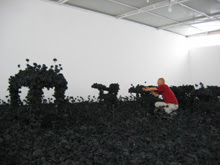
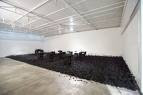
But I did enjoy the discussions at the day symposium the Tate held on the work of Helio Oiticica on 2nd June. It was an interesting mixture of academics, art curators, conservators, journalists and artists so the talks varied greatly in detail and in approach. And I was brave enough to spend time talking to some of the audience and speakers, in particular an artist called Cesar Cornejo, who is from Peru. He trained originally as an architect, did his sculptural training and PHD in Japan during the Fujimori years, and now does some installation work which he calls anti-architecture. In some ways his career is like Helio's travelling from 'concrete organizational purity' to work much more socially concerned.


La Cantuta - a grief for a Peruvian tragedy - Cesar Cornejo
2005
The symposium was on 'colour' in Helio Oiticica's work, but it was more about the artistic technicalities than the political issues about 'coded' and 'countercultural symbolism' - the latter is a very 'walking on eggs' area, and led to some quite impassioned (for academics) discussions !!! He does use a lot of yellow, but well before 1964, in his 'concrete period'. But as my Recife intellectuals of the 1950s and 1960s were quite plugged into this as well, I think the cultural debates within Brazil are more interesting and a more fruitful area of research than worrying about whether it is part of international trends of the time (Yves Klein etc). that is because it can be traced in poetry of the period in Recife, and possibly elsewhere. The literary writer I have been considering in relation to this is Carlos Pena Filho and his Soneto do Desmantelo Azul. This was the subject of an earlier film by Claudio Assis ( Amarelo Manga) made in 1993 and called in deference to internationalism Soneto do Desmantelo Blue.
Soneto do Desmantelo Azul
Então, pintei de azul
os meus sapatos
por não poder de azul pintar as ruas,
depois, vesti meus gestos insensatose colori,
as minhas mãos e as tuas...
Carlos Pena Filho(1929-1960)
Actually those who make claims about international influences (ie Western) as dominant are easily revealed as 'Euro-centric' First World cultural snobs. Same problem popped up over the discussions about Helio Oiticica's own post 1959 work, after he worked inthe Mangueira favela in Rio and discovered the structural realities of temporary housing. (It is very damp !.)Contemporary European work (on building materials and structures ) in the same area is derivative of activity in marginalized places, which it then 'universalizes' as a world concern which needs artistic expression, but in the process of course, further marginalizes the very cultural expression which told the story in the first place.
To see the work of Cesar Cornejo - see http://www.cesarcornejo.com/
To see information about Helio Oiticia exhibition - see http://www.tate.org.uk/
quinta-feira, 17 de maio de 2007
A sign to keep going ! Glauber Rocha at the Tate Modern
I often find that when I am very worried about keeping going on this work that I get a 'signal' - something I see on TV or read in the paper is about Brazil. I know it is just a nonsense and I see it because I am 'looking' for it mentally, but it makes me feel heartened, because despite the last post I really love Brazil and its people.
And just as I was working on this tragic 'knowing' episode my nephew arrived home from work and brought up the mail - because I really had been on the computer all day - a progress from television ! And there was the brochure for the Tate - I can't afford to be a member this year, but they still send the programme. And the Helio Otiticica exhibition is on, which I knew, and along with it in June and July - all the Glauber Rocha films the 'novo cinema' of the 1960s I need to see ! I have seen only one of them - O deus e o diable , which was shown to me by my Portuguese language teacher (Newton) in Recife. It features the music of Vila-Lobos and I knew about the film before I ever saw it thanks to another very clever Brazilian friend. You can see some of these on DVD, but it is far nicer to go to the Tate and watch them with other interested Brazilanistas and Brazilians living in London, because they are very political and interesting films - although like all such films, too intellectual for popular appeal, and then banned by the dictatorship. So I need to be finished!! I need to see these films so I need money and I need to be in London !!!!
The Oiticica exhibition is having a seminar about his use of colour - which is deeply involved in the same ironic work of the same period - essentially anti-symbolic, which is explored in my Amarelo Manga film also. So I have been on the right track, just far too slow to write it all down.
Oh god, I feel better.
I meant to give you all some detail about Amarelo Manga. It seems appropriate to choose one in relation to public grief and anonymous grief over death. One of the more shocking episodes in the film is when a dead male body - or 'yellow ham' is supplied by a corrupt official for a character interested in necrophilia, to use for target practice as a private 'turn on '. In contrast when the owner of the 'Hotel Texas' dies, there is much shock and consternation while the money is found for a coffin and he is laid out in the hotel with the residents singing traditional dirges. Both scenes are replete with referencing to other films and cultures, but the contrast is intended to reflect the difference between a community that 'cares' for whatever reason - and one that does not. One who 'needs' a priest and a ceremony and one who does not.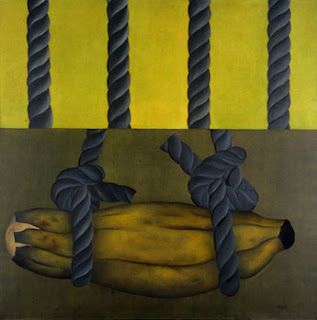
This picture is from 1973, by A H Amaral, called Banana in green and is typical of the ironic use of colour and 'realism' - the bananas and rope. The yellow and green as the colours of the Brazilian flag marked the artistic attempts to circumvent the censorship of the dictatorship and show the real truth. Amaral was in New York.
If you have never been to the Tate Modern in London, can I urge you to visit ? It is one of my favourite parts of London, and has completely changed the old 'South Bank' image. Cross the Thames from St Paul's Cathedral on the Millenium Bridge. Fabulous.
There is a seminar on Helio Oiticica and 'The Body of Colour' which will be webcast on 2 nd June 2007. See
www.tate.org.uk/onlineevents
See you all there!
And just as I was working on this tragic 'knowing' episode my nephew arrived home from work and brought up the mail - because I really had been on the computer all day - a progress from television ! And there was the brochure for the Tate - I can't afford to be a member this year, but they still send the programme. And the Helio Otiticica exhibition is on, which I knew, and along with it in June and July - all the Glauber Rocha films the 'novo cinema' of the 1960s I need to see ! I have seen only one of them - O deus e o diable , which was shown to me by my Portuguese language teacher (Newton) in Recife. It features the music of Vila-Lobos and I knew about the film before I ever saw it thanks to another very clever Brazilian friend. You can see some of these on DVD, but it is far nicer to go to the Tate and watch them with other interested Brazilanistas and Brazilians living in London, because they are very political and interesting films - although like all such films, too intellectual for popular appeal, and then banned by the dictatorship. So I need to be finished!! I need to see these films so I need money and I need to be in London !!!!
The Oiticica exhibition is having a seminar about his use of colour - which is deeply involved in the same ironic work of the same period - essentially anti-symbolic, which is explored in my Amarelo Manga film also. So I have been on the right track, just far too slow to write it all down.
Oh god, I feel better.
I meant to give you all some detail about Amarelo Manga. It seems appropriate to choose one in relation to public grief and anonymous grief over death. One of the more shocking episodes in the film is when a dead male body - or 'yellow ham' is supplied by a corrupt official for a character interested in necrophilia, to use for target practice as a private 'turn on '. In contrast when the owner of the 'Hotel Texas' dies, there is much shock and consternation while the money is found for a coffin and he is laid out in the hotel with the residents singing traditional dirges. Both scenes are replete with referencing to other films and cultures, but the contrast is intended to reflect the difference between a community that 'cares' for whatever reason - and one that does not. One who 'needs' a priest and a ceremony and one who does not.
This picture is from 1973, by A H Amaral, called Banana in green and is typical of the ironic use of colour and 'realism' - the bananas and rope. The yellow and green as the colours of the Brazilian flag marked the artistic attempts to circumvent the censorship of the dictatorship and show the real truth. Amaral was in New York.
If you have never been to the Tate Modern in London, can I urge you to visit ? It is one of my favourite parts of London, and has completely changed the old 'South Bank' image. Cross the Thames from St Paul's Cathedral on the Millenium Bridge. Fabulous.
There is a seminar on Helio Oiticica and 'The Body of Colour' which will be webcast on 2 nd June 2007. See
www.tate.org.uk/onlineevents
See you all there!
Now I really don't know what to do !
I feel in a very fragile state. And it is getting worse. Last post was very optimistic. In fact I was so optimistic that I e-mailed my supervisor to tell him what I had been doing. And got no reply. And then got too frightened to look at my e-mail which happens when I am feeling guilty and unable to cope. Along with certain physical symptoms. And so although I have done some work, for the last week or so I have been in a complete and utter funk, and have not written anything. I have put a wonderful organized plan on my Outlook calendar, and printed it all off and put it on my notice board. And I failed last Thursday to achieve the target. And I stopped. So I have been very upset about my bad financial situation and my marraige. So I sorted out my nephew instead of myself. Is this what happens when you have a breakdown? I feel incredibly isolated. the last two days I have slept on my own and got on the computer but only to do things like this. I am crying now. Such a waste if I can't get going.
I could have e-mailed a new contact about a meeting of Latin American educationalists in London today. I did not. I asked and got a little more money from my husband - just about enough to get me to London and back today. I have not gone. I could e-mail a dear friend in Brazil who encourages me to keep writing. I have another dear friend who was at University with me in New Zealand and who is gong there in September with her husband for the first time in many years. She is having an operation this week. I can't find her number.
This is so bad. I am so bad. And completely in a funk, stuck in the Suffolk countryside waiting for it all to come crashing down in my face, so my husband and children can all say I told you so!
A death in Recife: why I do this
I was doing all my time wasteful news searching in the blogs of some more organized friends and found in Recife they are all upset about a teacher who was shot dead this week in her car in Boa Viagem, just going to the supermarket. The young robbers (16, 17) had bought a gun to do robberies with, but then were so nervous when she tried to drive away that they shot her straight in the heart. Her name is Altina Margarida Marinho Coutinho, and she was 57 years old. Her family and friends are so upset that they have mounted a campaign for 'Peace for Tina', to try and do something about such tragic incidents. Tragic for everyone, for the poor young men and for Recife and for Brazil. There is a lot of comment from the 'punishment' brigade and some more reasoned words on how the young men, boys really, might think that street robbery is their only recourse in a land with such a great variation in wealth as Brazil. But Tina was no Brazilian 'millionaire'. She wasn't swanning around in diamonds and flashing US dollars. She cared about her work with all students and for those from the favelas like these young men just as much as her own children. That is why indiscriminate death is so shocking.
  And the solutions are very hard. I set out on a journey to do this dissertation because I visited North East Brazil and saw for myself. But I knew I needed to study in order to know what the problems were really and what solutions the local Brazilians felt could work. It is a slow process, just like my learning of the Portuguese language. It is easy to call on religious platitudes and fund simplistic 'street kid' projects. Brazil recently had a referendum on the ownership of guns to try and slow down the ease with which small pistols are sold to such 'children'. It failed.
 But in a country with such a high number of young people - there are not enough jobs. The education system is not robust enough to work with students who drop out like these. And for all the publicity for Tina, many more people, mainly young men, will die by the gun in Recife this week, with very little publicity and fuss from the media. This is my incentive to pass my Masters. It is not of any interest to my family. I think this is why I have such terror. I am alone in this. But I must do it.

I could have e-mailed a new contact about a meeting of Latin American educationalists in London today. I did not. I asked and got a little more money from my husband - just about enough to get me to London and back today. I have not gone. I could e-mail a dear friend in Brazil who encourages me to keep writing. I have another dear friend who was at University with me in New Zealand and who is gong there in September with her husband for the first time in many years. She is having an operation this week. I can't find her number.
This is so bad. I am so bad. And completely in a funk, stuck in the Suffolk countryside waiting for it all to come crashing down in my face, so my husband and children can all say I told you so!
A death in Recife: why I do this
I was doing all my time wasteful news searching in the blogs of some more organized friends and found in Recife they are all upset about a teacher who was shot dead this week in her car in Boa Viagem, just going to the supermarket. The young robbers (16, 17) had bought a gun to do robberies with, but then were so nervous when she tried to drive away that they shot her straight in the heart. Her name is Altina Margarida Marinho Coutinho, and she was 57 years old.
Her family and friends are so upset that they have mounted a campaign for 'Peace for Tina', to try and do something about such tragic incidents. Tragic for everyone, for the poor young men and for Recife and for Brazil. There is a lot of comment from the 'punishment' brigade and some more reasoned words on how the young men, boys really, might think that street robbery is their only recourse in a land with such a great variation in wealth as Brazil. But Tina was no Brazilian 'millionaire'. She wasn't swanning around in diamonds and flashing US dollars. She cared about her work with all students and for those from the favelas like these young men just as much as her own children. That is why indiscriminate death is so shocking. And the solutions are very hard. I set out on a journey to do this dissertation because I visited North East Brazil and saw for myself. But I knew I needed to study in order to know what the problems were really and what solutions the local Brazilians felt could work. It is a slow process, just like my learning of the Portuguese language. It is easy to call on religious platitudes and fund simplistic 'street kid' projects. Brazil recently had a referendum on the ownership of guns to try and slow down the ease with which small pistols are sold to such 'children'. It failed. But in a country with such a high number of young people - there are not enough jobs. The education system is not robust enough to work with students who drop out like these. And for all the publicity for Tina, many more people, mainly young men, will die by the gun in Recife this week, with very little publicity and fuss from the media. This is my incentive to pass my Masters. It is not of any interest to my family. I think this is why I have such terror. I am alone in this. But I must do it.Tina's modest car. For more details see Brazilian news sites: Try this http://www.folhape.com.br/folhape/materia_online.asp?data_edicao=14/05/2007
The Recife (and Brazil) streetwise warning for car thieves : The usual advice is to have money available in your car for robbers, stay still and give them what they want. But it is a very frightening experience, and no-one knows what you or the robbers will do if it happens.
sexta-feira, 27 de abril de 2007
In my father's den (New Zealand 2004)... a serious film review point by me!!!
I have finally got serious about commenting on film and put a 'review' remark on IMDB, partly because I get tired of all the crass and ignorant remarks by people who expect everything to be like dumb Hollywood stuff, or only happy enough for 12 year olds etc. And I would not bother except I meet so many nice ordinary intelligent young university students who think that this site is the best way to find out about movies - and it does seem to have some kind of remark for most movies that have at least subtitles in English. So here is a link to my first effort:
and can I ask you to look at the comment by Marilou of New York on the same page - because I didn't know she had commented, and she is my husband's cousin who grew up next door to him in Green Island, Dunedin, New Zealand but has lived in New York for over 25 years. She is not a budding film academic like me, but does a lot to support New Zealanders in the arts (especially music) in the USA. So if you can help her to get the film distributed in the USA, please...
If you read my comment you will see I had personal reasons for finding the film particularly revealing, as I lived in the area in which it was set (Central Otago) as an educated British immigrant teenager, an interesting experience ! It is very beautiful, as a hot dry mountain desert place that also has cold frosts in winter...
 this still from the film captures it perfectly.
I picked up on the migration issue really, because it is about a brother returning home from a journalistic career in the world's trouble spots on the death of his father, to confront the reasons why he left. It is a proper 'film noir' in plot, but the characterisation and issues discussed are what make it so good.
Anyway I am now going to do more of these for various films that I feel are not supported enough, on various sites. And I have some friends who do the same, so expect more links like this. But this blog is not going to be a mere 'stop' for passing the reader on to all sorts of other sites. I hate that. It is about growing in confidence to express my own views and some of my friends as considered and important. Gosh - v. serious !
Last point. I seem to be surrounded by people who spend a lot of time collecting and storing their own huge collections of videos, DVDs, itunes, even youtube clips, and passing them on and sorting them out, so they can then spend loads of time re-watching the same old re-runs and few films. Well I like to collect books, but at least it is easier to just dip into them and get the bit you want. And I still borrow them from the library, even if reading recent journal articles is easier if you can download them from Jstor or whatever. More serendipity and renewal that way.
I like to go to the cinema, maybe once a week, and then turn that film over in my mind and remember it.
This weeks film - Los Olividados (Luis Bunuel, Mexico, 1942??). Seen at Arts Cinema, Cambridge. Wonderful Black and White film about street kids in Mexico City. Precursor to Pixote(1989) and Cidade de Deus (2002) from Brazil and various other 'social' Latin American and European films. A newly restored print - but the English subtitles, probably the original are awful - listen to the Spanish, which is fairly 'standard' unlike the street language of Cidade de Deus.
There is a fallow deer sitting in my garden...
For the second time this year there is a young deer sitting in the garden... just in the middle near the greenhouse and it has got one front leg amputated.... We don't usually have them any more because some hideous neighbours secretly bought the paddock land behind us and put a fence up - plus they keep a large and stupid dog, so our wild life has been a bit depleted in recent years. I just went down to take a picture but frightened it, so it has escaped back under the trampoline and into my other neighbour's garden. If his son was around he would shoot it - but it looked quite healthy despite the injury.
I wonder about animal symbolism...? Last time I went for a 'thinking' drive in the countryside near here about thirty fallow deer charged across from one field to another in front of me !Yesterday I went down to Kent to take my appendix-scarred daughter and her flatmate back for the summer term. She is 20 today and having a bit of a party, and my older daughter is coming from London to join her and then going on to Zurich for the weekend with her boyfriend. When we were in Margate hospital with the doctors who finally woke up to the fact that she needed to have that appendix out right now, a seagull came down and tapped on the glass door of her room until they went. I try not to be superstitious !
Must say journey was v. bad to start with - had to go up the A14 between Cambridge and Huntingdon first - anyone who lives locally will know that this road is a minefield of frequent accidents and long traffic jams - and sure enough... luckily we only had about half an hour delay (for about 1 mile..!) because I was able to shoot off through the villages and because the jam had just started. By the time we were heading south again the tailback was huge. On to Canterbury crossing the Dartford Bridge and the A2 roadworks about 3pm which is optimum time to be there, and not too bad. Reminds me so much of the joy of driving in Otago and Canterbury in New Zealand last year - no traffic at all!
I took advantage of journey back with a nearly full tank of petrol paid for by my husband (rare of him at 95p a litre !) to drive right up the A13 into London, parking behind the Appeal Court at 7pm and going to my University Library in Chancery Lane, which is doing the civilized thing of being open 24 hours for a couple of months for 'exam revision'. It was the second time this week I had managed to get there - and I had left my student ID card in another jacket - luckily one of the security guards is a New Zealander and knows I'm a regular so he let me in, and I tucked myself up at the top of the post-grad clock tower with a nice blank room and my laptop and got a load of work done.
My University Library
It used to be the Public Record Office until it moved to Kew. A very high Victorian Gothic Grade I listed building converted at great cost to a modern library - but they had to keep all the old small rooms and mezzanine floors that used to house all the 'Rolls' and manuscripts, so the book shelving sequence is very long and hard to follow . As a professional Librarian I would have to say it is not entirely 'user-friendly', but very nice to work in.
 Clock Tower - haven for PostGrad thinking, but I always choose an internal room
Drove home at 1.30 am, only having to stop twice to refill the leaky radiator on my car - thanks to the 24 hour garage by the Millenium Dome - a regular stop of mine - thanks guys!
Actually the previous day I went to London by train to the Institute of Education so I will tell you about that in the next post - and why I now have a resurgence of faith in my dissertation.
I wonder about animal symbolism...? Last time I went for a 'thinking' drive in the countryside near here about thirty fallow deer charged across from one field to another in front of me !Yesterday I went down to Kent to take my appendix-scarred daughter and her flatmate back for the summer term. She is 20 today and having a bit of a party, and my older daughter is coming from London to join her and then going on to Zurich for the weekend with her boyfriend. When we were in Margate hospital with the doctors who finally woke up to the fact that she needed to have that appendix out right now, a seagull came down and tapped on the glass door of her room until they went. I try not to be superstitious !
Must say journey was v. bad to start with - had to go up the A14 between Cambridge and Huntingdon first - anyone who lives locally will know that this road is a minefield of frequent accidents and long traffic jams - and sure enough... luckily we only had about half an hour delay (for about 1 mile..!) because I was able to shoot off through the villages and because the jam had just started. By the time we were heading south again the tailback was huge. On to Canterbury crossing the Dartford Bridge and the A2 roadworks about 3pm which is optimum time to be there, and not too bad. Reminds me so much of the joy of driving in Otago and Canterbury in New Zealand last year - no traffic at all!
I took advantage of journey back with a nearly full tank of petrol paid for by my husband (rare of him at 95p a litre !) to drive right up the A13 into London, parking behind the Appeal Court at 7pm and going to my University Library in Chancery Lane, which is doing the civilized thing of being open 24 hours for a couple of months for 'exam revision'. It was the second time this week I had managed to get there - and I had left my student ID card in another jacket - luckily one of the security guards is a New Zealander and knows I'm a regular so he let me in, and I tucked myself up at the top of the post-grad clock tower with a nice blank room and my laptop and got a load of work done.
My University Library
It used to be the Public Record Office until it moved to Kew. A very high Victorian Gothic Grade I listed building converted at great cost to a modern library - but they had to keep all the old small rooms and mezzanine floors that used to house all the 'Rolls' and manuscripts, so the book shelving sequence is very long and hard to follow . As a professional Librarian I would have to say it is not entirely 'user-friendly', but very nice to work in.
 Clock Tower - haven for PostGrad thinking, but I always choose an internal room
 Because this is too beautiful !
 This is the distracting daytime view from the tower - at night the lights are really cool too!
 And this is the Round Room - Reference Library - too quiet to disturb others with laptop noise, but it always make me feel a 'serious' researcher when I work in there.
Drove home at 1.30 am, only having to stop twice to refill the leaky radiator on my car - thanks to the 24 hour garage by the Millenium Dome - a regular stop of mine - thanks guys!
Actually the previous day I went to London by train to the Institute of Education so I will tell you about that in the next post - and why I now have a resurgence of faith in my dissertation.
terça-feira, 3 de abril de 2007
Margate is...suprising !!

Buenos Ayres, Margate.
I always thought Margate was very tacky, but I didn't really know it at all. My husband used to do some work at Ramsgate in the winter months many years ago, and that was dire in those days. I don't like overdone British Beach places in principle - I must do a blog on my favourite beaches. And I went to Aldburgh and Lowestoft with my New Zealand Tourist nephew last week, because we have had such lovely sunny days recently, but they are different to Margate.
Anyway I took Adri to Margate with me on Monday and took him down to the seaside area at lunchtime, to find that as well as the wonderful but decayed Regency houses at the front, there is a whole interesting 'old town' behind to explore. The other 'tourists' consisted of hundreds of European teenagers who poured off the train (good place to park - £2.20 for the day). They are probably here for the compulsary 4 week English lessons - we get the same in Cambridge and my sister Dublin has mostly Spanish youngsters there. So excitable! The local white youth are overdressed and badly mannered, lots of people with drinks, but also lots of different nationalities.
I think Margate is a place where a lot of asylum seekers went a few years ago, because they have the cheap boarding houses and it is close to London. Anyway money is being spent there, and if I could snap up one of the Regency houses before they are all turned into retirement appartments I would! (I deny being a capitalist, but I appreciate spacious historic houses)
Ari was happy to explore the cash machines and games areas, and win himself a disgusting orange furry dice. My good friend Joc, who is a professional clarinettist, and also at University in Kent doing a MA in performance, just did a recital at the Winter Gardens in Margate - and was staggered to find herself playing to over 200 people!!!! And it was sunny enough to sit on the beach yesterday too.
More Latin Americana.. Row of cheap hotels by the Railway station, with a view over the beach and town but no sun - priced between £22.50 and £11.50 a night!!! Best bit - The street is called Buenos Ayres (sic!!!) . British/International/Observation without over-diagnosis I suspect. I comment no more.
Assinar:
Postagens (Atom)