quinta-feira, 28 de fevereiro de 2008

Shallow and inconsequential

Taking the more serious mode

...or road. I am writing this in the morning when I should finish my dissertation. I have done the printing off some useful procrastination kickers from the internet. I have got dressed and had 2 cups of tea, a banana, 2 plums and a hot cross-bun with blackcurrent jam (no wonder the weight stays 0n!). It is early enough to take the bus to Bury and sit in the Library there...

~~~~~~~~~~

But on Tuesday at the Departmental Book Launch I met a fellow post-grad who has finished his PHD and has his viva in 2 weeks time !!!
But I know that it has taken 4 plus years, cost him relationships,some of his hair and sent him to the depths of despair at times. But he is finished, and so should I. Any way he has been researching in Recife like me, and knows my subject Amarelo Manga, so he asked me an intelligent question about it, and I could answer, so I just know it is time to wrap it all up. But yesterday I could not force myself to write, especially as it was very sunny outside, and is again today. Eventually I went out to met my nephew in Cambridge to see Be Kind, Rewind, which I justified as kind of the same rethinking of film cultures that I find in AM, but of course it is gussied up as a feel good movie and a laugh with the leading actors, so the reviews do not really tackle the internal criticism inplicit in the title of rethinking the whole grip of the Hollywood dream machine on our expectations of movie culture. I must see if there are any more considered discussions about this film.But not as a distraction from my own writing, you understand. Just as an added understanding....


Introspective as some of the discussions were on Tuesday (there were lots of anthropologists and people from other universities there), I found myself in serious conversations about New Zealand with a couple of people who had spent some time there. One is doing a PHD on tattos and Polynesia. They both had reservations about the country and the people which were more incisive than the usual gushing about the scenery and the food. That made me feel more emotionally settled about my own mixed feelings about my friends and relatives still there.

My younger sister who completed her Masters with a first last year while holding down a full time job (admittedly below her professional capability, and in the same university) is treating me to a weekend in Birmingham (no laughing, our mother was born there). And she also lives away from New Zealand because she finds Europe more interesting. But she has been looking at writing about women in sport, which is actually something that is much more equal and better done in New Zealand these days. Every experience and location has its influence. But mine is now Brazil and I want to spread the word. So I have a major incentive to be finished and give her something to read from me. And there is more, but I realise that I am in danger of putting all my limited social life online and unmasking all my friends and enemies. So to the serious work...


The picture by the way, is from an old CD of National Geographic pictures, available for use on web-sites it says, but marked by that publication's habit of cute pictures of natives in the Amazon that is quite naive tourist and racially demeaning too. But as his face is hidden and he represents a metaphor for my own instincts at the moment I will risk the anthropologists critique. Sorry to anyone who feels offended by the idea of attributing internal feelings onto other peoples in the photographic representation, but that is part of my dissertation writing too. Just to clarify to myself. Stop digging a hole, girl !!

domingo, 24 de fevereiro de 2008

Red Shoes, Black Shoes.

Red Shoes

I don't actually want this particular picture of red shoes, although they are similar to a pair I actually own. I was trying to find on the website http://www.spaininfo.co.uk/ a picture I had on their printed brochure of a girl in a red dress trying to choose from a dozen boxes of red shoes - a tribute to shopping in Spain that did not seem to be on the website. Not that I doubt the Spanish shops, just that a trip to Lisbon via Madrid on a tight budget en famille 5 years ago did not allow me to find out, and that is the only time I have been in Spain.
Although as my current escape dreams are full of solitary travelling lately, I have been toying with the idea of flying to the Algarve (cheap) and using a rental car or the local buses to travel around Southern Spain. I have a vain hope that in mid-winter the reputation of Alhambra as tourist ridden may prove unjustified.

However I digress from shoes. I already own 2 pairs of fancy red shoes and acquired 2 more pairs of be-jewelled party shoes in the sales. 1. a wonderful beige velvet with open toe and jewels and 2. a more strident purple silk with diamante stars, both now squirreled away in my fancy clothes suitcase and away from the accountant's gaze (aka known as my husband). The cost was low, about £40 for the two. The pleasure and the guilt strange (due in part to my huge credit card hangover - even at 0%). So what was the attraction of choosing red shoes? After all I rarely wear them. It was the idea of family, fantasy, generations and shoes.


Black shoes

My oldest daughter was home last weekend for the large Catholic funeral of the father of a school friend who had been in Australia for exactly four days when the call came to say he had died of a heart attack on a French golf course. His wife, owner of a recently acquired post-graduate certificate as a theatre nurse was in pieces in grief. As was my daughter's friend. Fine art graduate and lover of fashion as my daughter is, she set out for the funeral from the bus-stop outside our house in London fashion black layered coat,leggings, scarf and dress, and had a lift down to Newmarket within a minute, probably on account of her wooden style high heeled black shoes. She had the sense to take the other woman at the bus stop with her, although the male driver was almost certainly a neighbour - we all know the vagaries of our local buses, so seldom seen on time, not to gallantly give those waiting at the bus stop a lift whenever we can. She returned some hours later in a black patent pair with high heels and jaunty brass gold buckles, as 1980s a pair of shoes as I have seen in a while. She claimed that the discomfort of the other shoes had led her into New Look to find them for only £15. As she left early the next morning with her father and one of our larger suitcases for her flight to Whistler later that night, I discovered she had left the new shoes for me to find. Clearly unsuitable for her ski holiday ! And a generous gift from a girl, taller, thinner, blonder and half a shoe size larger than me. But they fit !!! I feel like a queen. Why was it such a lovely gift, shoes only worn to one funeral ? And why was I, sober matron that I should be, so cheered by a pair of jaunty buckles and a high heel ? If I desire the shoes, will some one desire me? I know a nice footman who might! Is shallow female desire so materialistic and body personalised?? She who would normally read a book instead? Madame Bovary was never more satisfied with fashion over thought. Does my daughter know how I think myself young these days.

I return today revitalised and anxious to go back to my academic writing and thinking. And ignoring the very sick feeling in my stomach at the thought of disappointing the accountant who wants me to stop. Incompatibility after 30 years stalks our household. I am very afraid. But too afraid to talk. Because he cannot argue in terms of Virginia Woolf.

This Mrs Dalloway is metamorphosing. I am very afraid of becoming Madalena.

BROKEN DREAMS


Just after my last blog I discovered that my lovely Sony Vaio laptop had accidently been crushed. I have now had five weeks getting my data off the damaged hard drive and lost all my bibliographic listings (in Endnote) and some of my Mindmaps. I am back online with a second hand Dell, and mananged to reload most of my software and original word and pdf docs. I also lost my personal photographs which was a huge blow. I feel a bit jinxed, especially as the culprit won't own up. But the insurance claim is in, so I may get a few pennies. Not enough to buy a lovely new Vaio with mobile internet access though.

Anyway, here I am with a few things to catch up. Firstly to say that I went to a very good seminar at the Latin American Department at Cambridge University where I met a husband and wife team of economists from Recife, with some very exciting work on inequality in Brazil, and especially on education, which made me think very hard about my original feelings about Brazil and why I am studying it. I need to put something together about this next time.

And then I had a very interesting telephone conversation with my Brazilian film academic about the poem that I mentioned last time. We were discussing the translation of the poem which can alter the 'feel' of it, and why I felt it was rather cinematic. Now I need to edit my writing about it and put it up on this web.

And next Tuesday, 26th February 2008, the Portuguese and Brazilian Studies Department at King's College, London is having a collective Book Launch and Film screening, especially the book from their recent research on the Cultures of the Lusophone Black Atlantic / edited by Nancy Naro, Roger Sansi-Roca and David Treece, and several other recent publications. Film Screening is Jongos, Calangos and Folias. Black Music, Memory and Poetry. Starts with the film at 5pm. See www.kcl.ac.uk/schools/pobrst for details.

quarta-feira, 16 de janeiro de 2008

And start all over again....

Pick myself up, etc.. (popular song). Well, even though I have not managed to finish the dissertation for which I gave up my blog in order to concentrate on writing, I am still hanging around in academia and even, somehow, my marraige. Several friends have revealed their own blogs which is fascinating when you know them well, but I feel too mindful of my daughters and my own privacy to inhabit Facebook. So I have decided to recommence this anonymous 'publicity' journal, because I want to carry on publicising the wonderful creative and academic achievements of friends, and accounts of films, seminars and conferences that I go to, which are too often unpublished and lost. It will still be a place for me to work out a few ideas and thoughts of my own.
I am just writing some thoughts for a Brazilian friend who is embarking on an academic career in film studies, and found myself returning to a poem by Manuel Bandiera (He is a 20th century Brazilian poet whose picture is on the right side of this blog). I first looked at this poem in relation to thinking about urban imagery and spaces in relation to Recife for my Amarelo Manga work. But my friend is considering ideas about 'realism', and did a paper about the film Children of Men and realism in Science Fiction film. Anyway this is the poem in English translation by Richard Slavitt - I don't agree entirely with his version, but that is the business of my paper !

Reality and Image

The skyscraper soars into the clear air washed clean by the rain
and descends to its reflection in a mud puddle in the courtyard.
Between reality and image, on the dry ground between the two,
four pigeons go for a walk.


It does seem almost universal, but I should contextualise it and say it was written in 1947, when the poet was living in an apartment block in Rio de Janeiro, Brazil, which was then a fairly new experience, and so I suppose a specific time and place to comment on urban living. And it is so popular in it's apparant simplicity that it has been recently used (2006) in Brazil's final school examination for university entrance - the Vestibular. And for those of you who relate intellectual and artistic activity to European trends, it does have a wiff of French contemporary 'existentialism' philosophically speaking, or religious 'spirit' for those whose leanings in semiotic interpretations are so inclined.
My analysis is picking at the 'visual' - textual to 'mind's eye' puzzle. So I will try and let you know if I succeed next time. And hope I get this loaded up !!!

sábado, 16 de junho de 2007

Cesar Cornejo - Education and Peru and Colour in Culture


Siempre la misma historia (The same old story), Cesar Cornejo, 2004.

I am off to to London to see the third Glauber Rocha film at the Tate tonight - Terra em Transe. It is so sad that the curator of this film series, who I have spoken to, did not organize a 'talk' session of some kind, to go with the series. It would be great to have a discussion with some of the other people who are coming to see these films.

But I did enjoy the discussions at the day symposium the Tate held on the work of Helio Oiticica on 2nd June. It was an interesting mixture of academics, art curators, conservators, journalists and artists so the talks varied greatly in detail and in approach. And I was brave enough to spend time talking to some of the audience and speakers, in particular an artist called Cesar Cornejo, who is from Peru. He trained originally as an architect, did his sculptural training and PHD in Japan during the Fujimori years, and now does some installation work which he calls anti-architecture. In some ways his career is like Helio's travelling from 'concrete organizational purity' to work much more socially concerned.

La Cantuta - a grief for a Peruvian tragedy - Cesar Cornejo

2005


The symposium was on 'colour' in Helio Oiticica's work, but it was more about the artistic technicalities than the political issues about 'coded' and 'countercultural symbolism' - the latter is a very 'walking on eggs' area, and led to some quite impassioned (for academics) discussions !!! He does use a lot of yellow, but well before 1964, in his 'concrete period'. But as my Recife intellectuals of the 1950s and 1960s were quite plugged into this as well, I think the cultural debates within Brazil are more interesting and a more fruitful area of research than worrying about whether it is part of international trends of the time (Yves Klein etc). that is because it can be traced in poetry of the period in Recife, and possibly elsewhere. The literary writer I have been considering in relation to this is Carlos Pena Filho and his Soneto do Desmantelo Azul. This was the subject of an earlier film by Claudio Assis ( Amarelo Manga) made in 1993 and called in deference to internationalism Soneto do Desmantelo Blue.

Soneto do Desmantelo Azul
Então, pintei de azul
os meus sapatos
por não poder de azul pintar as ruas,
depois, vesti meus gestos insensatose colori,
as minhas mãos e as tuas...
Carlos Pena Filho(1929-1960)


Actually those who make claims about international influences (ie Western) as dominant are easily revealed as 'Euro-centric' First World cultural snobs. Same problem popped up over the discussions about Helio Oiticica's own post 1959 work, after he worked inthe Mangueira favela in Rio and discovered the structural realities of temporary housing. (It is very damp !.)Contemporary European work (on building materials and structures ) in the same area is derivative of activity in marginalized places, which it then 'universalizes' as a world concern which needs artistic expression, but in the process of course, further marginalizes the very cultural expression which told the story in the first place.


To see the work of Cesar Cornejo - see http://www.cesarcornejo.com/
To see information about Helio Oiticia exhibition - see http://www.tate.org.uk/

quinta-feira, 17 de maio de 2007

A sign to keep going ! Glauber Rocha at the Tate Modern

I often find that when I am very worried about keeping going on this work that I get a 'signal' - something I see on TV or read in the paper is about Brazil. I know it is just a nonsense and I see it because I am 'looking' for it mentally, but it makes me feel heartened, because despite the last post I really love Brazil and its people.


And just as I was working on this tragic 'knowing' episode my nephew arrived home from work and brought up the mail - because I really had been on the computer all day - a progress from television ! And there was the brochure for the Tate - I can't afford to be a member this year, but they still send the programme. And the Helio Otiticica exhibition is on, which I knew, and along with it in June and July - all the Glauber Rocha films the 'novo cinema' of the 1960s I need to see ! I have seen only one of them - O deus e o diable , which was shown to me by my Portuguese language teacher (Newton) in Recife. It features the music of Vila-Lobos and I knew about the film before I ever saw it thanks to another very clever Brazilian friend. You can see some of these on DVD, but it is far nicer to go to the Tate and watch them with other interested Brazilanistas and Brazilians living in London, because they are very political and interesting films - although like all such films, too intellectual for popular appeal, and then banned by the dictatorship. So I need to be finished!! I need to see these films so I need money and I need to be in London !!!!

The Oiticica exhibition is having a seminar about his use of colour - which is deeply involved in the same ironic work of the same period - essentially anti-symbolic, which is explored in my Amarelo Manga film also. So I have been on the right track, just far too slow to write it all down.

Oh god, I feel better.

I meant to give you all some detail about Amarelo Manga. It seems appropriate to choose one in relation to public grief and anonymous grief over death. One of the more shocking episodes in the film is when a dead male body - or 'yellow ham' is supplied by a corrupt official for a character interested in necrophilia, to use for target practice as a private 'turn on '. In contrast when the owner of the 'Hotel Texas' dies, there is much shock and consternation while the money is found for a coffin and he is laid out in the hotel with the residents singing traditional dirges. Both scenes are replete with referencing to other films and cultures, but the contrast is intended to reflect the difference between a community that 'cares' for whatever reason - and one that does not. One who 'needs' a priest and a ceremony and one who does not.

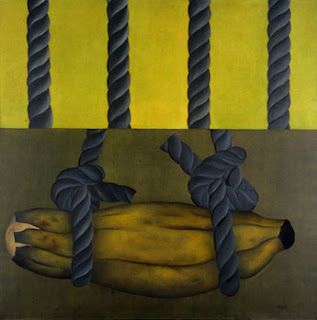
This picture is from 1973, by A H Amaral, called Banana in green and is typical of the ironic use of colour and 'realism' - the bananas and rope. The yellow and green as the colours of the Brazilian flag marked the artistic attempts to circumvent the censorship of the dictatorship and show the real truth. Amaral was in New York.
If you have never been to the Tate Modern in London, can I urge you to visit ? It is one of my favourite parts of London, and has completely changed the old 'South Bank' image. Cross the Thames from St Paul's Cathedral on the Millenium Bridge. Fabulous.
There is a seminar on Helio Oiticica and 'The Body of Colour' which will be webcast on 2 nd June 2007. See
www.tate.org.uk/onlineevents

See you all there!

Now I really don't know what to do !

I feel in a very fragile state. And it is getting worse. Last post was very optimistic. In fact I was so optimistic that I e-mailed my supervisor to tell him what I had been doing. And got no reply. And then got too frightened to look at my e-mail which happens when I am feeling guilty and unable to cope. Along with certain physical symptoms. And so although I have done some work, for the last week or so I have been in a complete and utter funk, and have not written anything. I have put a wonderful organized plan on my Outlook calendar, and printed it all off and put it on my notice board. And I failed last Thursday to achieve the target. And I stopped. So I have been very upset about my bad financial situation and my marraige. So I sorted out my nephew instead of myself. Is this what happens when you have a breakdown? I feel incredibly isolated. the last two days I have slept on my own and got on the computer but only to do things like this. I am crying now. Such a waste if I can't get going.

I could have e-mailed a new contact about a meeting of Latin American educationalists in London today. I did not. I asked and got a little more money from my husband - just about enough to get me to London and back today. I have not gone. I could e-mail a dear friend in Brazil who encourages me to keep writing. I have another dear friend who was at University with me in New Zealand and who is gong there in September with her husband for the first time in many years. She is having an operation this week. I can't find her number.
This is so bad. I am so bad. And completely in a funk, stuck in the Suffolk countryside waiting for it all to come crashing down in my face, so my husband and children can all say I told you so!

A death in Recife: why I do this


I was doing all my time wasteful news searching in the blogs of some more organized friends and found in Recife they are all upset about a teacher who was shot dead this week in her car in Boa Viagem, just going to the supermarket. The young robbers (16, 17) had bought a gun to do robberies with, but then were so nervous when she tried to drive away that they shot her straight in the heart. Her name is Altina Margarida Marinho Coutinho, and she was 57 years old. Her family and friends are so upset that they have mounted a campaign for 'Peace for Tina', to try and do something about such tragic incidents. Tragic for everyone, for the poor young men and for Recife and for Brazil. There is a lot of comment from the 'punishment' brigade and some more reasoned words on how the young men, boys really, might think that street robbery is their only recourse in a land with such a great variation in wealth as Brazil. But Tina was no Brazilian 'millionaire'. She wasn't swanning around in diamonds and flashing US dollars. She cared about her work with all students and for those from the favelas like these young men just as much as her own children. That is why indiscriminate death is so shocking. And the solutions are very hard. I set out on a journey to do this dissertation because I visited North East Brazil and saw for myself. But I knew I needed to study in order to know what the problems were really and what solutions the local Brazilians felt could work. It is a slow process, just like my learning of the Portuguese language. It is easy to call on religious platitudes and fund simplistic 'street kid' projects. Brazil recently had a referendum on the ownership of guns to try and slow down the ease with which small pistols are sold to such 'children'. It failed. But in a country with such a high number of young people - there are not enough jobs. The education system is not robust enough to work with students who drop out like these. And for all the publicity for Tina, many more people, mainly young men, will die by the gun in Recife this week, with very little publicity and fuss from the media. This is my incentive to pass my Masters. It is not of any interest to my family. I think this is why I have such terror. I am alone in this. But I must do it.

Tina's modest car. For more details see Brazilian news sites: Try this http://www.folhape.com.br/folhape/materia_online.asp?data_edicao=14/05/2007

The Recife (and Brazil) streetwise warning for car thieves : The usual advice is to have money available in your car for robbers, stay still and give them what they want. But it is a very frightening experience, and no-one knows what you or the robbers will do if it happens.